Donkeys
The Darling Buds of MayDonkeys are both a practical addition to the Larkins’ gymkhana and its most unruly performers: recruited to enliven the pony events, they turn a carefully arranged country gathering into a comedy of stalled starts, unexpected flight, and unintended destinations. Their role is not simply to furnish a joke. The animals’ resistance and responsiveness repeatedly make human plans provisional, while the four little donkeys waiting in the stable also provide the setting for Mariette and Mr Charlton’s private intimacy.
Purpose and Preparation
Pop brings donkeys into the gymkhana because he considers the usual programme—trotting, riding, leading rein, jumping, bending, and walk, trot, canter, and run—liable to become dull. He calls the familiar spectacle too “horseface like,” with long-faced spectators difficult to distinguish from mares, and decides that the event needs something to enliven it. Donkeys promise a different sort of entertainment, though Pop’s additional private jokes, including a plan involving a firework beneath Miss Pilchester, reveal that he is already imagining disruption as part of the day’s fun.
The animals are also a committee negotiation. Pop secures four for racing: two are hired, while their owners bring two more the night before. He hopes that three further donkeys will arrive. The distinction matters to the preparations: the animals are a small, assembled contingent, not part of the ordinary Larkin household. On the morning of the gymkhana, Pop sends Mariette and Mr Charlton to feed and water them while he attends to his many other jobs and Miss Pilchester’s expected arrival.
In the Stable
The four donkeys are tied in the stable Pop built with a larger equestrian future in mind: one day, he imagines, almost every member of the family will have a pony or horse to ride, with Ma perhaps the exception. For now, the purpose-built stable holds the smaller animals required for the day’s races. Their presence gives the preparations a concrete, domestic scale: before the public contest and its crowds, there is the ordinary task of going across the yard to feed them.
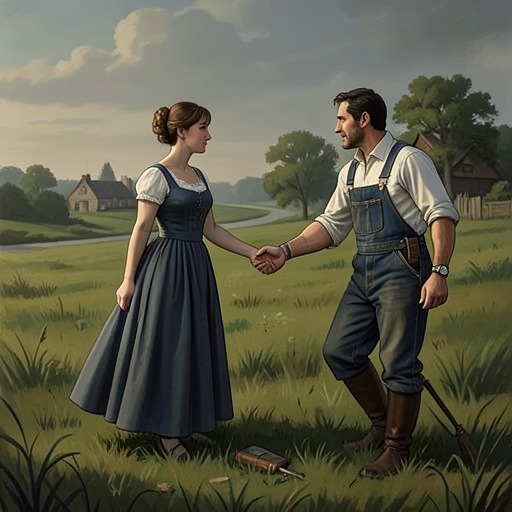
That errand becomes a private scene for Mariette and Mr Charlton. In the half-dark stable, among the donkeys, he takes her in his arms and kisses her; she says she has been waiting for that first kiss and returns to him. As a second kiss continues, the animals stir and swish their tails. Their movement interrupts the lovers’ privacy just enough for Mariette to laugh at having never been kissed among donkeys before. Mr Charlton’s quick reply looks ahead to the cocktail party, linking the stable’s furtive tenderness to the larger celebrations still to come. The donkeys do not merely sit behind the romance as scenery: their restless movement shapes the moment and gives Mariette its teasing turn.
The Races
On the day itself, the donkeys become part of the gymkhana’s accumulating disorder. Miss Pilchester asks where they are, while the Brigadier dryly remarks that some donkeys have been there all night. The joke depends on the practical confusion of the event as much as on the animals: the programme has run late, the loudspeaker’s wires have already tripped Miss Pilchester, and questions about entries and facilities compete for attention.
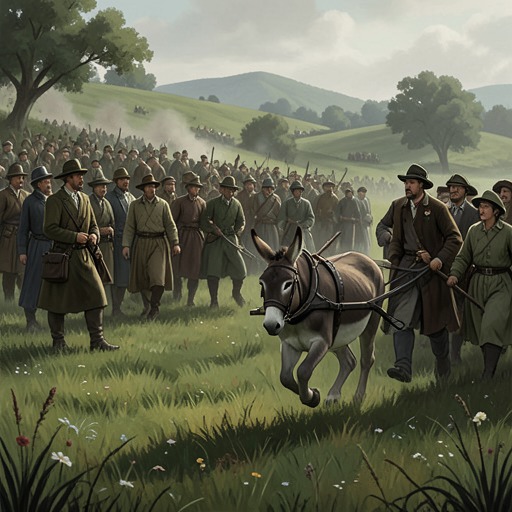
The men’s donkey race establishes how little the riders control their mounts. A quarter of an hour before Miss Pilchester’s event, Montgomery and Mr Charlton take part. Most of the donkeys, including Mr Charlton’s, need carrots to get them moving. Whiskey Johnny, a pale, sagacious animal, wins without needing them. Mr Charlton rides three yards before falling off; his donkey bolts past the tea tent and on toward the river. There, its route carries it into the long grass where a soldier and a young blonde are embracing, unaware of the watchers. When Pop goes to retrieve the animal, he finds it staring at the couple with apparent interest. After being led away a few paces, it turns back, ears pricked, as if it would like to return. The race has spilled beyond its track, and the donkey’s attention extends the episode into the lovers’ secluded riverside scene.
Pop chooses Jasmine for Miss Pilchester, who has been persuaded to enter the ladies’ donkey Derby after he secured a silver cup for it. The cup is engraved for an angling competition, an incongruity Pop sees no reason to worry about. Miss Pilchester, facing competitors aged sixteen or seventeen, feels neither young nor effervescent and dislikes the donkey’s coarse hair beneath her calves. Pop tells her to grip with her knees and hang on “like grim death”; his advice proves more accurate than his control of the event.
At the start Jasmine stands stubbornly still. Pop pushes against her rump and heaves, but the donkey seems to have sunk its feet into the ground. While Miss Pilchester is still considering how ghastly the experience is, the loudspeaker barks out an announcement about a three-year-old, Anne Fitzgerald, who has lost her mother. Jasmine cocks her ears. The sound changes the scene: she breaks through the last waving arcs of carrots, leaves Pop on the ground, and scatters the people in her path. Miss Pilchester clings on as instructed, and within thirty seconds Jasmine is back at the river among the grasses, water-lilies, and irises. The same animal that would not start for Pop responds decisively to the loudspeaker, carrying its rider away from the race and back to the place where it had earlier encountered the soldier and his companion.
Comic Agency and Consequences
The races make donkeys a counterforce to the event’s human organization. The committee has a schedule, competitors, carrots, a loudspeaker, and a cup; the animals do not reliably follow any of it. One needs inducement to move, another wins without it, Mr Charlton is unseated almost immediately, and Jasmine remains immovable until a sudden sound sets her bolting. Their behavior converts the planned spectacle into a sequence of reversals, in which the people responsible for directing the contest are repeatedly made spectators to what the animals do.
Jasmine’s escape also brings the public race into awkward contact with a private world. The donkey first pauses to watch the embracing couple, then returns there with Miss Pilchester aboard. The contrast between the official competition and the secluded riverside encounter supplies the episode with its particular embarrassment: the animal’s route places the dishevelled Miss Pilchester in the middle of an intimacy that she was not seeking to witness. Through the donkeys, the gymkhana’s comic energy is not confined to the course; it follows the animals wherever their movement leads.
Across these episodes, donkeys have several distinct functions without becoming interchangeable props. They are animals Pop acquires and tends for a specific sporting purpose, the occasion for a tender scene between Mariette and Mr Charlton, and competitors whose unpredictable responses redirect both race and narrative. Their stubbornness frustrates human intention, while their curiosity and alertness to sound give them a limited but consequential agency. The gymkhana’s entertainment depends less on a smooth contest than on the gap between what its organizers expect and what the donkeys actually do.